
What Abdominal Muscles Get Cut During a C-Section?
Updated with the latest research March 21, 2021
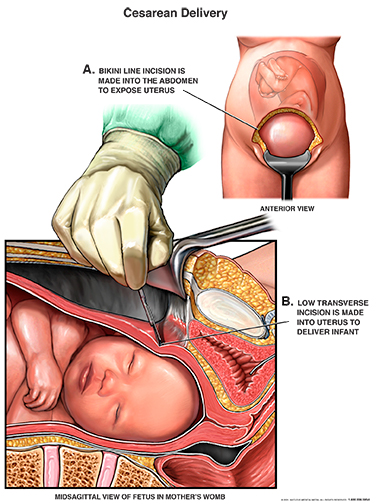
This article will show you various research studies and other qualified OBGYN references that demonstrate exactly how a C-section cuts a person’s abdominal muscles, thereby affecting a mother’s function and recovery. This is critical information for any fitness professional to understand.
In addition, it is critical that any fitness professional who works with women also understands that the industry discussion that points women toward the idea that “no muscles are cut” is often disempowering, by directing your client’s attention away from what’s really important: function and recovery.
As many of you know, C-section rates are at all-time highs in hospitals around the world, and in most cases, appropriate rehabilitative therapy for this “Class Major Surgery” is practically non-existent.
Does it even matter if it’s the “muscle” that gets cut, versus the tendon of that muscle?
Those who suggest that “abdominal muscles are not cut during C-section” provide information that is incomplete, and often misleading. (By the way, doctors and others who are “educated” provide this kind of information all the time). Consider what would happen if a surgeon took a scalpel to cut across the very bottom of your calf muscles (gastroc/soleus) and suggested, “don’t worry, i’m not going to cut your calf muscles at all!” Instead, the surgeon tells you that they are going to cut only the calf “tendon” (the achilles tendon).
Should this make you feel better about the result in your function and well-being? In other words, will your ability to walk, or even stand, be affected any differently because they’ve cut the tendon, rather than the muscle itself?
Remember, the tendon is the tissue that the muscle becomes just before it attaches to the bone.
For those who’ve never had an education in anatomy and physiology, it may seem appealing to think that your muscle isn’t getting cut. However, if you are a professional who has learned about physiology, you would probably understand that cutting the tendon causes as much damage to one’s ability to function as would a similar cut in any particular muscle.
In fact, “tendons generally have a more limited blood supply than muscles. This makes them somewhat slower healing structures in comparison to muscle,”[1] and “once a tendon is injured, it almost never fully recovers[2].” Oops, maybe celebrating “not cutting the muscle” is a bit premature.
And we aren’t yet taking into account the fact that the fascia – which is also being cut during a C-section – is an extraordinarily intelligent system. “Recent studies have elaborated the role of muscular fascia as [an] essential force transmitter in muscular dynamics.”[3]
Altogether, perhaps we should heed the advice from a recent (2019) Medical News Today article: “Untreated tendon and ligament injuries increase the risk of both chronic pain and secondary injuries. People should seek prompt medical care rather than ignoring the pain.”[4]
Perhaps people should also start offering better advice and better treatment to our postpartum mothers who undergo C-section. There must be standard post-operative therapy for C-section in every country whose hospitals offer this “Class Major Surgery.”
Finally, even if it were correct to say that “no muscles are cut”, cutting the tendon & fascia causes at least the same damage, if not more, to the abdominal wall. Wasting time in this debate completely misses the important point that real therapy must be performed regardless.
References showing how a C-Section Cuts Various fascia, tendinous sheaths, and muscle.
As everyone on both sides of this debate would agree, “fascia” is definitely cut during a C-section. Johns Hopkins Health defines fascia as “a thin casing of connective tissue that surrounds and holds every organ, blood vessel, bone, nerve fiber and muscle in place. The tissue does more than provide internal structure; fascia has nerves that make it almost as sensitive as skin.”[5] The resulting scar tissue directly affects the muscles in that area:
- “In the region of the abdomen south of the belly button, there are two layers of fascia (continuous connective tissue) that run external to the abdominal muscles and four layers that run between and/or deep to the abdominal muscles. When the abdominal wall undergoes surgical incision, each of these fascial layers is penetrated. As the incision heals, scar tissue anchors each of the layers together, interrupting the ability of each of the muscular layers to glide over one another as they contract and relax.”[6]
According to a 2015 research study, “The choice of the type of abdominal incision performed in caesarean delivery is made chiefly on the basis of the individual surgeon’s experience and preference. A general consensus on the most appropriate surgical technique has not yet been reached…pain, due to nerve damage, seems to represent the most relevant cause of maternal postsurgical discomfort.”[7]
“Chapter 60: Cesarean Delivery” of Textbook called “OB/GYN Hospital Medicine: Principles and Practice” tells doctors, “Appropriate knowledge of the anterior abdominal wall is necessary to perform cesarean delivery. The layers encountered when making a low-transverse abdominal wall incision include the following:”[8]
- “The thicker rectus fascia created by the aponeurosis of the external and internal obliques and the transversus abdominis muscles”
- “The midline muscles of the anterior abdominal wall: the rectus abdominis and the pyramidalis”
You can see that not only is there a direct reference to the rectus abdominis (the “6-pack”) and pyramidalis muscles, but also to the tendon[9] portions of the external obliques, internal obliques and transverse abdominis.
Already this should put to rest any debate that questions, “Do muscles get cut during C-section?”
There are a couple different cuts that will initially be made for a C-section. The very lowest (and therefore possibly construed as “farthest from the abdominal muscles” is called the Pfannenstiel incision [Sounds like “Fan-An-Steil”]. As of 2010 research in Gynecological Surgery, “The preferred transverse incisions worldwide are the Pfannenstiel and the Joel-Cohen (JC) incisions.”[10] Pfannenstiel often wins because it is considered to be more cosmetically pleasing[11],[12],[13] (which does not necessarily mean that it is functionally the best way to cut through the muscles.)
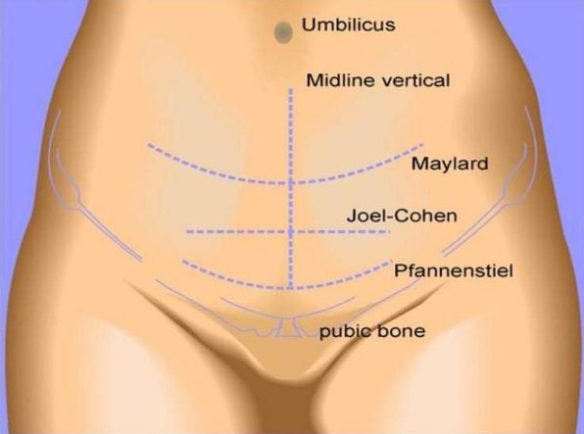 Image Above[14]: “Different types of initial skin incisions that can be performed for a cesarean delivery”[15]
The OB/GYN text states, “At the level of a low-transverse incision, the fascia entirely overlies the rectus muscles.”
Texas Tech University Health Sciences Center says that the Pfannenstiel incision means that the rectus abdominis muscle is cut:
- “Layers [are] incised are as follows: skin, superficial fascia (fatty and membranous), deep fascia, anterior rectus sheath, rectus abdominis muscle, transversalis fascia, extraperitoneal connective tissue, and peritoneum.”
Note that all of those above layers are incised, leaving the following layer – the uterus – to be potentially given a different style of cut altogether, depending on the surgeon’s preference and discretion.
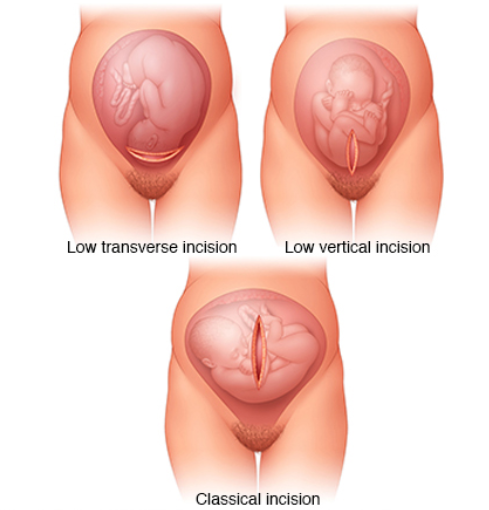 Image Above[16]: Uterine Incision (different from initial skin incisions). “Before any incision is made the surgeon should be aware of the general location of the placenta and the fetus. There are a few choices of incision type that will depend entirely on the location of the fetus/placenta. A lower transverse incision can be advantageous because it can lead to less blood loss, less need for bladder dissection, and a lower risk of rupture in subsequent pregnancies.”[17]
By the way, the uterus is cut during a C-section. And the uterus is the muscle in which the fetus resides for 9 months. In fact, the uterus is so much of a legitimate muscle that it is often considered perhaps the strongest muscle in the human body.[18],[19],[20] By definition, a C-section cuts this muscle. “The uterus consists of the serosal outer layer (perimetrium), the muscle layer (myometrium), and the inside mucosal layer (endometrium). All three of these layers are incised.”[21]
How did society start talking about whether or not muscle cutting is done anyway?
Research studies can be a quirky thing. It is rather common that the wording of a study gets misconstrued in the media (as well as amongst the varying online opinions). “For science reporters, new studies are irresistible — a bold new finding makes a great headline.”[22]
One of the reasons why this debate emerged may be related to how one of the most prevalent and heavily-cited studies was worded back in AJOG in 2005. In fact, this was a “review” of tons of previous scientific research, which means that these scientists sought to analyze literally everything to date, “All randomized trials that covered a surgical aspect of cesarean delivery were included in the review.”[23]
Authors wrote, “Rectus muscle cutting has been studied in 3 trials that included 313 women…These women were assigned randomly to either Maylard (muscle cutting) or Pfannenstiel (no muscle cutting) techniques.”[24]
The thing to note as to why this wording is important is that these authors were making a classification for the sake of contrasting the two different incisions (muscle-cutting vs non-muscle-cutting). They did not intend to clarify function or even the accuracy of whether the “non-muscle-cutting” group actually had perhaps the “lower portion of their muscles cut,” compared to a more “middle portion.” In other words, based upon the scientific references earlier mentioned – the ones that have already acknowledged that muscles are indeed cut – these authors’ terminology is technically incomplete, albeit perfect for clarifying the concepts intended in their 2005 review.
The main point here is that one of the most regarded C-section studies in the last couple decades decided to use terminology that suggested that “non-muscle-cutting” was an option, even though that isn’t completely accurate.
Fitness professionals who are wondering, neither cut was “associated with any difference in operative morbidity, difficult deliveries, postoperative complications, or pain scores in these studies” although there was “a trend for better strength in the Pfannenstiel group.”[25] In other words, complications and pain were equal regardless of where the cut was performed, however the lower Pfannenstiel group had a trend for better strength.
Before we wrap this subsection, it’s worth noting that “Most clinicians use the scalpel as little as possible, opening layers bluntly”[26] instead. Blunt means that the surgeon will use his or her fingers to pull the incision apart once the initial incision has been made. Research so far indicates that this technique has been associated with shorter operating times[27], and less injury to the tissues[28], including maternal blood loss[29]. Just to be clear, regardless of whether the tissue is expanded via cutting versus blunt technique, damage is still being done to the tissues, and therefore function and postpartum therapy are still the appropriate focal points.
Summary
Post C-section, appropriate muscular therapy is necessary to restore proper function to the abdominal wall. Multiple muscles are definitely cut during a C-section, although some muscles will be cut at their tendinous sheaths, or end points, rather than across the belly of the muscle, which may have been the cause of some confusion. In addition, surgeons will commonly pull the tissues apart with their hands, rather than continuing to incise with surgical equipment. Regardless of the terminology used when describing a C-section, trauma to the abdominal wall is the result, and appropriate muscular reconditioning is essential for the well-being of postpartum women.
If you would like a continuation of this article, one that focuses further into the various C-section techniques, recommends educational C-section videos you can watch, discusses various techniques in closing the various layers that are incised, and further discusses the muscles and fascia that are cut, please visit: “C-Section Explained More Fully.
If you are pregnant or want more information on C-Sections, check out our Prenatal Wellness Course, designed specifically for preconception and prenatal women!
If you are a Fitness or Wellness Professional, check out more tips on training women in all stages of life here!
[1] https://symmetryptaustin.com/healing-expectations-for-different-tissue-types/#:~:text=Tendon%20Healing%20Considerations&text=Tendons%20generally%20have%20a%20more,tension%20on%20the%20tendon%20tissue.
[2] https://research.cornell.edu/news-features/tendons-injuries-and-healing
(Cornell Research Site)
[3] https://www.frontiersin.org/articles/10.3389/fphys.2019.00336/full
(2019, Frontiers in Physiology.)
[4] (2019) https://www.medicalnewstoday.com/articles/326858#injuries
[5] https://www.hopkinsmedicine.org/health/wellness-and-prevention/muscle-pain-it-may-actually-be-your-fascia
[6] https://www.pelvichealing.com/treatment/scar
[7] https://www.ncbi.nlm.nih.gov/pmc/articles/PMC4315586/
[8] https://obgyn.mhmedical.com/content.aspx?bookid=2511§ionid=206170950
[9]Aponeurosis is defined by Britannica as: “a flat sheet or ribbon of tendonlike material that anchors a muscle or connects it with the part that the muscle moves.” https://www.britannica.com/science/aponeurosis
[10] https://gynecolsurg.springeropen.com/articles/10.1007/s10397-010-0560-9
[11] https://gynecolsurg.springeropen.com/articles/10.1007/s10397-010-0560-9
[12] https://obgyn.mhmedical.com/content.aspx?bookid=2511§ionid=206170950
[13] https://www.ajog.org/article/S0002-9378(05)00500-4/fulltext
[14] https://www.stepwards.com/?page_id=3610
[15] https://www.stepwards.com/?page_id=3610
[16] https://www.stepwards.com/?page_id=3610
[17] https://www.stepwards.com/?page_id=3610
[18]https://thedaisyfoundation.com/the-uterus-5-reasons-to-shout-about/#:~:text=By%20weight%2C%20the%20uterus%20is,that%20can%20birth%20a%20baby.
[19] https://www.livescience.com/32823-strongest-human-muscles.html
[20] https://www.loc.gov/everyday-mysteries/biology-and-human-anatomy/item/what-is-the-strongest-muscle-in-the-human-body/
[21] https://www.ncbi.nlm.nih.gov/books/NBK546707/
[22] https://www.vox.com/science-and-health/2017/3/3/14792174/half-scientific-studies-news-are-wrong
[23] https://www.ajog.org/article/S0002-9378(05)00500-4/fulltext
[24] https://www.ajog.org/article/S0002-9378(05)00500-4/fulltext
[25] https://www.ajog.org/article/S0002-9378(05)00500-4/fulltext
[26] https://www.ajog.org/article/S0002-9378(05)00500-4/fulltext
[27] https://gynecolsurg.springeropen.com/articles/10.1007/s10397-010-0560-9
[28] https://gynecolsurg.springeropen.com/articles/10.1007/s10397-010-0560-9
[29] https://pubmed.ncbi.nlm.nih.gov/23123380/
ORIGINAL BLOG POSTED JAN 21, 2013
I want to share a Great Question asked by Samantha.
We love answering all of your questions! Please send us any and all questions you have.
Q: A client of mine (pregnant) had a c-section on her last one and wants to know what happened below her belly button that made it so hard to lose her pooch. Is that diastasis recti, perhaps? I think she thought something was actually cut, a horizontal pooch. But they don’t actually cut the muscles in a c-section, do they? Just pull them apart?
A: In a c-section, 6-7 incisions are made throughout the process. Although the abdominal muscles themselves are not cut, the fascia which connects them is cut and this allows the doctor to pull the muscles apart in order to get to the next layer of fascia. Who knows how many extra nicks happen during c-sections and where they happen. The key is with all of the incisions/severings of the body, all of the nerves are also cut. Separating the muscles causes nerve damage, loss of blood supply, and damage to the muscle itself. Without proper retraining of these muscles, it is extremely difficult to get access to the muscles. Without being able to access the muscles it is very difficult to tone them, leaving them flabby or pooch like tummy.
But even with all of this, the most common reason for distended bellies, long-lasting pooches is misuse or under-use of the core musculature that probably started way before she was pregnant. It seems 9 out of 10 pregnant moms we assess do not have access to their TVA or control over their pelvic floor muscles. Without access to these muscles, the belly gets much larger, and the muscles continue to distend and become even more dysfunctional. Add a c-section to that and you have a great explanation to the never going away pooch:)
Also regarding diastasis, she definitely could have had one, and if she did not before the c-section there is a chance she did after as they separate the muscles at the fascia where they attach. Sometimes the doctors make a few stitches to reattach the muscles to the fascia.
I feel many women have a feeling of relief their muscles are not cut, but in reality, it is kind of misleading. Although a scalpel does not cut through the rectus muscles, the fascia that is attached to them is cut, and then the muscles are separated from the fascia by pulling them apart. This causes a separation. The other thing to consider is, while this is the most common way c-sections are performed, some hospitals may use a cautery that burns the skin and cut through all the layers at once instead of making all the little incisions. With this https://learning.tradethiopia.com/ method, the muscles are actually cut. It’s important to ask the doctor exactly how they perform their c-sections to know for sure.
Here we share what the number one exercise is for preventing diastasis, strengthening the core, and helping prevent c-section.
Would you like to prepare to recover quickly from a C-section (or use the most up-to-date research to improve your chances to avoid this major surgery altogether)? Empower yourself with Fit For Birth’s Prenatal Wellness Course. Not only will you be inspired to maximize your health during this critical time period, but you’ll be coached on how to do a self-assessment on your core, with specific corrective exercises to prepare your core optimally.
OR if you’re a wellness professional and want to feel empowered to work with women at any stage of their pregnancy or postpartum journey, check out our Pre & Postnatal Corrective Exercise Specialist Course and our Pre & Postnatal Diastasis & Core Consultant Course.
the explanation given by you is in so simple way that it will definitely relieve lots of women who were in doubt that what happened to their abdominal muscles during c section delivery. very nice article sir.